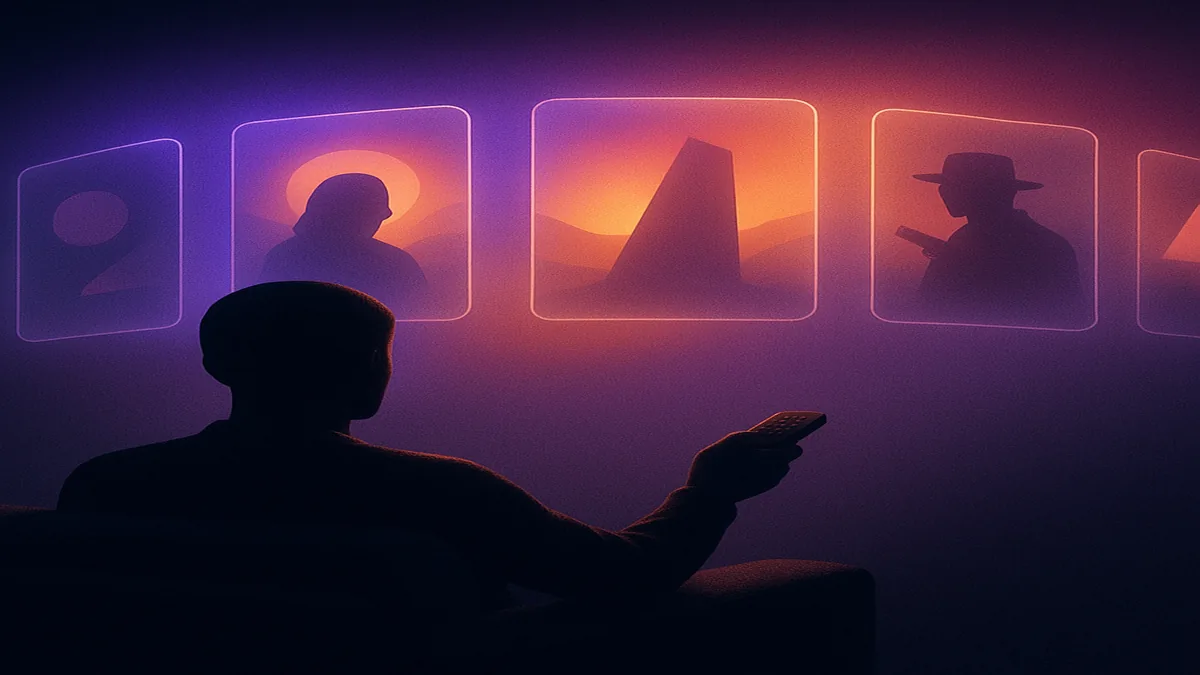
Two minutes. That's all the attention most people will give to picking what to watch tonight. Two minutes scrolling past Netflix tiles, two minutes hovering between Letterboxd lists, two minutes that end with someone giving up and rewatching The Office for the seventh time.
We've been thinking about that two minutes for a long time. And we kept coming back to the same observation: the format that solved the "what do I want to consume next?" problem for music, for short-form video, for fashion — was vertical, sound-on, infinite, and instantly engaging. Reels. Shorts. TikTok.
So we built a feed of movie trailers in exactly that shape, and it changed how we recommend things forever.
The problem with thumbnail grids
Open any streaming service and you'll see the same UX: a wall of static poster thumbnails arranged in genre rows. The poster is doing all the work. It's trying to communicate genre, tone, era, cast, and emotional weight in a 2:3 rectangle the size of a business card.
Posters are great when you already know the title. They're terrible at making you feel something for a film you've never heard of. A bad poster has killed more movies than bad reviews. Meanwhile, the same film with a 60-second trailer — score swelling, faces in close-up, one good line of dialogue — is suddenly a Friday night plan.
The poster grid was built for video stores in 1995. It was never the right shape for discovery.
Why trailers in 2026
Three things changed:
- Bandwidth is no longer the bottleneck. Vertical video at decent quality streams instantly on the worst LTE connection. Five years ago this was infrastructure-dependent; now it's table stakes.
- Vertical is the dominant attention format. People raised on TikTok don't pause to read a tagline. They swipe. If your discovery UX doesn't work with thumb-up, thumb-down velocity, you're invisible.
- Trailer cuts have evolved. A good trailer in 2026 is a 60–90 second piece of editing that knows it has 7 seconds to earn the rest of your attention. The form has matured.
That last point is the one most product teams miss. A trailer is not a "preview." It's a self-contained piece of marketing built on the same attention curves as a TikTok edit. It opens with a hook, escalates, lands a punchline. It's already in the right format. We just had to put it in the right container.
What we built
Our trailer feed is exactly what it sounds like: vertical, sound-on by default (with a tap-to-mute), one trailer per screen, infinite scroll, snap-to-card. Tap any trailer to drop into the full title page. Long-press to save to your library.
A few details that took longer than we'd like to admit:
- Sound on, not autoplay-everywhere. A grid of muted preview videos is worse than a grid of posters. We play one trailer at a time, with sound, in focus. When you scroll past, it pauses. That's it. No background chatter, no battery drain.
- No ads between trailers. This was a hard call. Trailers themselves are advertising for movies, so adding a second layer of ads on top would be psychotic. The feed exists to help you decide. The deal is: we curate, you watch, you decide.
- One tap to act. Every trailer card has Want / Seen / Skip buttons in the same place. The same gestures you use in Swipe work here too. Discovery and triage in one pass.
The metric we care about
For most discovery products the north star is "watches per session." For us it's something else: time-to-decision. The seconds between "I'm bored, what's on?" and "I'm watching this one."
Pre-trailer-feed, our average user took 4 minutes 12 seconds to commit to a title. After trailer feed shipped, it dropped to 1 minute 48 seconds. Half the time. More importantly, follow-through rate (started → finished) went up 22%, because people are committing to titles they actually want, not titles they tolerate.
What trailers can't do
A few honest caveats. Trailers are powerful but they're not the whole product:
- They lie. Trailers are sales copy, and the best ones tell you the movie is something it isn't. (See: every romance trailer cut for an action audience.)
- They spoil. A 90-second trailer often shows you the third-act reveal. We can't fix that — the studios cut them, not us.
- They favor the visually loud. Quiet, slow, or character-driven films lose to explosions in any 60-second cut. We're testing a "directors' picks" feed for that.
This is why we still recommend the traditional swipe deck too. The trailer feed is for exploration — you're in the mood for something, not sure what. Swipe is for triage — you've got a list of candidates, you want to thin it. Different jobs, different tools.
What's next
A few things we're working on:
- Personalized trailer feed. Right now you get a curated mix. Next quarter the feed adapts to what you've Wanted, Seen, and Skipped — the same engine that powers our recommendations.
- Friends layer. See which trailers your friends saved this week. We've been resisting social features for a long time but watch parties keep coming up in user interviews.
- Game and book trailers. Games already have great trailers (the medium is built for them). Books are harder, but BookTok has shown that a 60-second cover-and-quote treatment can sell a novel. Worth experimenting with.
The bigger pattern
Reels worked for music because they let you sample a song without committing to listen to all of it. Same for short-form video — you sample, you commit. The trailer feed is the same shape applied to a different medium.
The lesson, if there is one: most "discovery" products solve the wrong problem. They optimize for catalog browsing — making a 10,000-title library feel navigable. The actual user need is different. People aren't looking to navigate a library. They're trying to decide what to do for the next two hours of their life.
Show them 60 seconds of footage with the volume up. They'll know.
If you haven't tried the trailer feed yet, give it a swipe. And if you've got opinions about what should be in it — too many superhero trailers? Not enough indie horror? — tell us. The feed is curated, and curation is a conversation.